Blog Post 207
This blog post is a logical deep dive into Stoic perception, specifically how to reframe obstacles as opportunities for growth. It moves from the internal theory of mindset to the practical "grit" of handling a crisis.
2/7/2026
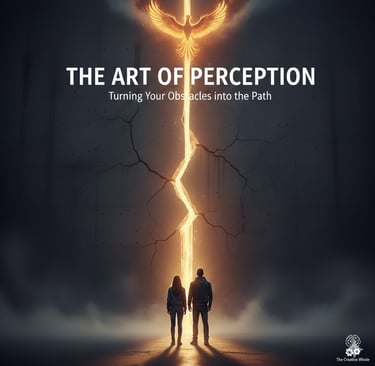
The Art of Perception: Turning Your Obstacles into the Path
In the journey of the creative and the critical thinker, we often hit a wall. We see a setback—a failed project, a lack of subscribers, or a personal hardship—and we label it as a "stop sign." But as we recently explored on The Creative Whole podcast, the Roman Emperor Marcus Aurelius offered a different logic: "The impediment to action advances action. What stands in the way becomes the way."
If you feel like you are standing in the dark, remember that light only becomes visible when it hits an object. In the same way, your character and growth only become visible when they hit an obstacle. The first step to flipping the script is mastering Perception.
1. Controlling the Controllables
A major source of creative burnout and personal anxiety is the "Scatter Effect"—trying to exert force on things that are outside of our reach. Whether it’s a global pandemic, an economic shift, or even just a slow driver in the lane ahead of you, the logic remains the same: if you cannot change it, your emotional investment in it is a wasted resource.
In our discussion, we touched on the reality of the workplace. You may have great ideas, but if you don't have "access to the controls," fighting the system only leads to a disempowered state of mind. Real power is found in the surrender of the external. When you stop fighting the storm, you can finally start bailing the water out of your own boat.
By focusing exclusively on what is within your influence—your effort, your reaction, and your next move—you move from being a "passive receiver" of bad luck to being an active participant in your own rescue. This isn't just a feel-good sentiment; it is a tactical advantage. When you stop worrying about the wind, you can finally focus on the sails.
2. The Power of Objectivity
We often view our lives through a "subjective lens" colored by fear, past trauma, or ego. This is what Carlos and I discussed as the "E over I" problem—when your Emotions rise above your Intelligence. When emotion takes the wheel, facts become distorted.
To remain objective is to see the situation for what it actually is, not what your fears tell you it might become. Think of the story of Pericles and the solar eclipse. While his crew saw a bad omen in the sudden darkness, Pericles used a simple cloak to show them that darkness is just a physical property, not a spiritual judgment.
As a creator, you must be the narrator of your own story. A narrator stands outside the action; they see the "frame" of the shot. If you can hover above your situation and look at it with the cold eye of a scientist or a photographer adjusting their strobes, the "scary" elements lose their power. Facts are your friends. When you strip away the labels of "good" or "bad" and simply look at the "what is," you find the leverage needed to move the mountain.
3. The Peace of the Present
The human mind is a time traveler, and rarely is that a good thing for our mental health. We have a habit of spiraling—looking back at the "woulda, coulda, shoulda" of the past or jumping into the "what ifs" of the future.
There is a profound logical framework for this:
The Past leads to Depression: You are mourning things that cannot be changed.
The Future leads to Anxiety: You are fearing things that haven't happened yet.
The Present leads to Peace: You are dealing with the only reality you actually possess.
Staying present doesn't mean you don't plan for the future or heal from the past; it means you don't let them paralyze you. Just like Rubin "Hurricane" Carter, who was wrongly imprisoned but refused to let his mind be incarcerated, you must choose to stay in the "now."
When you are faced with an obstacle, your only job is to handle the next sixty seconds. Then the next sixty. This focus on the present moment creates a "Phoenix" effect. It is in the heat of the current challenge—not the comfort of the past—where you are stretched and stressed until you grow. The roots of a tree only search for water when the surface is dry. Your current obstacle isn't there to stop you; it is the very thing that is forcing you to grow deep enough to reach the next level of your purpose.
The Creative Whole Takeaway: Next time you hit a wall, don't look for a way around it. Look for the light breaking through the cracks. The obstacle isn't in your way; the obstacle is the way.